

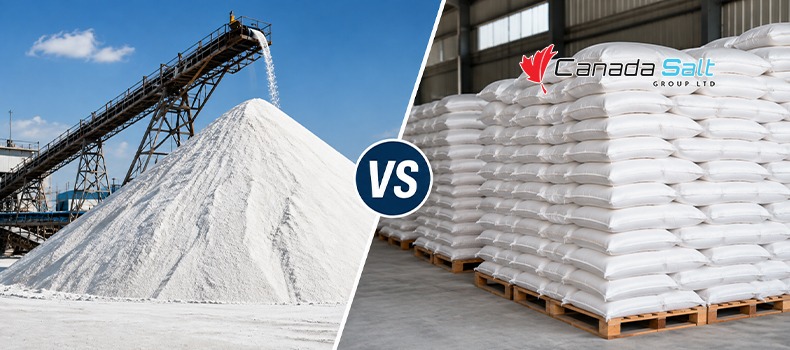
Bulk Salt vs Bagged Salt for Industrial Operations: Which Is More Cost-Effective?
Salt is a widely used material in industrial and commercial sectors, such as winter maintenance, water treatment, manufacturing, and other applications. For businesses that use large amounts of salt, there are two options: Bulk salt and Bagged salt. Bulk salt is delivered in large quantities, while bagged salt comes in packaged units that are easier to handle and store.
Now, which one is more cost-effective? It depends on salt usage, storage space, delivery needs, and application of salt. In this article, we explore Bulk salt vs. Bagged salt for industrial operations and which is more cost-effective.
What is Bulk Salt?
Bulk salt is supplied in large quantities without individual bags. It is commonly delivered by truck and unloaded directly into storage areas or other suitable storage facilities. Bulk salt is preferred by businesses that need large amounts of salt, including municipalities, property owners, water treatment companies, and road maintenance contractors. Bulk salt does not require individual packaging; businesses can purchase and receive large quantities of salt. Hence, it can be a practical option for operations with high salt consumption.
What Is Bagged Salt?
Bagged salt is packaged into individual bags, making it easier to transport, handle, and store in smaller quantities. Bagged salt is commonly used for retail operations, water softening operations, and smaller industrial operations. Additionally, bagged salt can be easier to move around a facility because employees can handle individual bags rather than using bulk handling equipment.
Bulk Salt vs Bagged Salt for Industrial Operations: Cost Comparison
Comparison of Bulk salt and bagged salt involves many factors, such as price as one of the important factors. Here are other factors to be considered
1. Product Cost
- Bulk Salt: For large businesses that purchase large quantities of salt, bulk salt is cost-effective. Because the product does not need to be individually packaged and there are no packaging-related costs.
- Bagged Salt: Includes packaging costs, as it will be packaged in smaller quantities. Hence, the price per tonne may be higher compared to Bulk salt.
However, the difference in product price should be compared with the actual application. If your business only needs a smaller quantity, purchasing Bulk salt will not justify your savings and storage requirements.
2. Delivery Costs
- Bulk Salt: It is delivered in larger quantities. As a result, businesses that can accept larger amounts of salt may benefit from fewer deliveries and lower transportation costs per unit.
- Bagged Salt: It may require frequent deliveries because each shipment contains a smaller quantity of salt. This increases the transportation costs.
Hence, bagged salt can be suitable for businesses that do not have storage space or equipment needed to receive bulk salt deliveries.
3. Storage Requirements
- Bulk Salt: Generally, bulk salt requires a dedicated storage area for Bulk salt delivery and storage. The storage area needs to be designed to handle the quantity of salt being purchased.
- Bagged Salt: It can be stored on pallets or in designed indoor storage areas without requiring a large dedicated salt pile.
However, preparing a Bulk storage facility requires a significant investment. On the other hand, bagged salt can often be stored on pallets or in designed indoor storage without requiring a large dedicated area. Hence, bagged salt may be more economical for smaller businesses with limited space.
4. Labour and Handling Costs
Labour costs should be included while calculating the total cost of the salt.
- Bulk Salt: It can be handled manually or with equipment such as forklifts or jacks. It can be dumped in larger areas with the help of this equipment.
- Bagged Salt: Moving individual bags involves labour; hence, labour cost is included in the total cost of the salt.
Therefore, bulk salt may offer greater labour savings for high-volume operations, while bagged salt can be easier to manage with smaller quantities.
5. Waste and Product Management
- Bulk Salt: It may be exposed to moisture if it is not stored correctly. The right storage measures should be followed to protect the product and maintain its stability.
- Bagged Salt: It comes with an additional layer of packaging that can make handling and storage more precise. However, damaged bags result in product loss and can create additional clean-up requirements.
Hence, businesses should follow proper storage practices and should protect salt from unnecessary moisture exposure. Reducing waste can improve the overall cost-effectiveness of your salt supply regardless of whether you purchase bulk or bagged salt.
When Is Bulk Salt More Cost-Effective?
Bulk salt is generally a strong option for businesses that
- Use large quantities of salt
- Have large storage space
- Have recurring bulk salt orders
- Accepts large deliveries
- Have equipment for handling bulk material
- Looking to reduce packaging costs
- Want to reduce the number of deliveries
For these businesses, bulk salt can provide a lower cost per unit and can improve handling efficiency. For example, a company which uses large amounts of salt throughout the winter may find purchasing Bulk salt more practical than buying a number of individual bags of salt.
When Is Bagged Salt More Cost-Effective?
Bagged salt can be the better option for businesses which
- Use smaller amounts of salt
- Have limited storage space
- Are looking for easy manual handling
- Have irregular salt requirements
- Require controlled salt quantities
- Do not have bulk-handling equipment
For these businesses, the higher unit price of bagged salt may be balanced by lower storage and equipment costs.
How to Choose the Right Salt Supply Option?
When choosing between bulk and bagged salt, firstly consider your operational needs rather than focusing only on the purchase price. The key aspects to consider before choosing the right salt supply options are calculating the monthly and annual usage of salt for your operational requirements. Consider your available storage space and evaluate whether it can accommodate bulk salt. Review your delivery requirements and equipment needed to unload and move the bulk salt. Calculate labour costs to assess the total cost of the salt, and finally evaluate your demand. If your salt requirements are increasing, switching to bulk supply can be more economical as your purchasing volume increases.
Conclusion
For businesses with high salt consumption, large storage, and the ability to receive larger quantities of salt, bulk salt provides better value. In contrast, bagged salt can be a more feasible option for smaller operations, limited storage areas, and businesses that need easier handling. At last, the best option depends on your business requirements. By considering product price, delivery, storage, handling, and waste management together, you can find out which salt supply method provides the best overall value to your business.
If you are looking for a reliable salt supplier, Canada Salt Group Ltd offers bulk salt, bagged salt with pickup and delivery services across Ontario and the GTA, and large bulk order coverage across North America.