
Different Types of Salt Storage Domes
Salt storage domes play a key role in Canadian winter maintenance operations. Most organizations like municipalities, snow removal contractors, transport departments and commercial property managers depend on road salt to keep their roads, parking lots and walkways safe during the winter season. Proper storage is important to prevent moisture from seeping into the salt lot. In this article, we will look into the different types of salt storage domes, each with its unique advantages, so that organizations can choose the right one according to their operational requirements.
Types of Bulk Salt Storage Domes
1. Traditional Circular Salt Domes
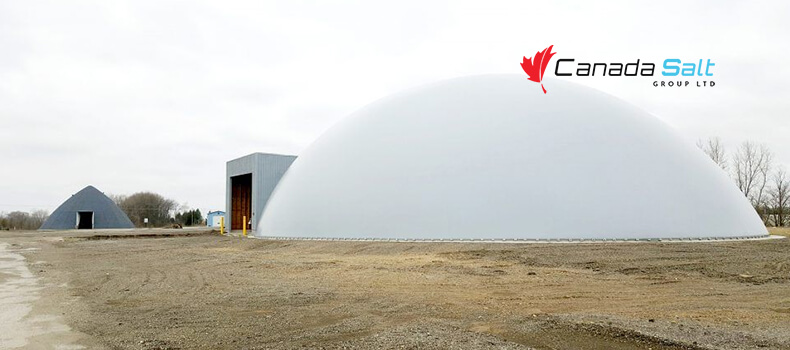
Traditional circular doms are the most commonly seen structures in Canada. They are usually designed with curved roofs that make the snow and rain slide off easily while providing more space for the salt. Due to their round structure, the movement of vehicles for loading and unloading becomes easier, and they can easily withstand heavy snow and winter winds.
Materials like wood, steel or engineered fabric systems are placed on concrete walls. Municipal road maintenance yards usually prefer this kind of structure to store bulk material in a compact area, due to its ability to provide excellent durability and long-term performance.
2. Elongated Salt Domes
Elongated salt domes are similar to traditional salt domes but have a longer rectangular or oval layout with a curved dome roof design. These domes are better for organizations that need higher storage capacity and better traffic flow. Due to this extra length, multiple vehicles can operate at a time, even during busy snow removal periods.
Elongated domes are commonly used by municipalities, highway maintenance companies and industrial facilities that require bulk salt for their operations during winter. Other deicers like salt, sand mix, and liquid deicers can be stored in these extra-spaced salt domes.
3. Fabric Salt Storage Domes
Fabric salt storage domes have become popular because they are affordable and faster to install. They are constructed using galvanized steel frames along with strong fabrics that are resistant to rust, corrosion and weather conditions. A major benefit of choosing fabric domes is their natural light penetration. The membrane allows natural light, which reduces the need for artificial light by lowering the energy consumption.
In the Canadian climate, where salt can cause serious corrosion, engineered fabric is a great choice to withstand rust and chemical damage.
4. Wooden Salt Domes and Barns
Wooden salt domes are the oldest and most widely used storage structures from the decades. They are constructed using pressure-treated wood, a concrete foundation and protective roofing systems. Wood is a perfect choice in winter because it works well in cold climates and provides insulation. Wooden domes are an affordable option for small municipalities and organizations with limited budgets.
Some wooden domes have highly constructed concrete walls so that salt will not directly come into contact with the wood. It needs more maintenance than steel or fabric ones. Still, a properly constructed wooden dome can last longer with less maintenance.
5. Steel Salt Storage Structures
Steel salt storage domes and sheds are designed for maximum durability and long-term performance. These structures use galvanized or corrosion-resistant steel frames combined with engineered roofing and reinforced foundation to withstand harsh environmental conditions. Steel structures are commonly chosen for large-scale operations because they can support wider spans and higher storage capacities.
Due to the corrosive nature of the road salt, modern steel salt domes come with a protective layer or bunker walls to avoid direct contact of the salt with the metal. This helps to reduce the maintenance costs and improve the life of the building.
6. Salt Sheds and Hybrid Dome Systems
Hybrid domes have the features of domes and conventional salt storage spaces. Hybrid salt storage systems are often built when there is a limited storage space or when the organization needs a customized design. Some hybrid storage systems have partitions to store other materials like treated salt or liquid brine.
Organizations that need temporary storage choose salt sheds. But most of the organizations are looking towards closed salt storage facilities as they provide better protection against moisture and other environmental hazards.
Choosing the Right Salt Storage Dome
The selection of the right salt storage dome depends on various factors like storage capacity requirements, site size, local weather conditions, equipment accessibility and maintenance that make the decision process simpler. Canadian municipalities and contractors look for snow load resistance and corrosion protection as important factors when deciding to choose salt storage domes.
Organizations should consider the future and choose the storage dome wisely. Choosing an expandable storage or flexible design can offer better value.
Conclusion
During winter, Canadian roads, parking lots and driveways are highly affected by snow and ice. There is a need for reliable salt storage solutions to maintain safety and operational efficiency. Choosing the right type is important to protect your salt from external elements like moisture, dust and rodents and ensure a consistent supply in the winter season.
At Canada Salt Group Ltd, we deal with high-quality road salt and salt storage solutions across North America. Our dedication towards reliable supply, efficient logistics and long-term customer partnerships makes us a great choice for businesses that are looking for bulk salt storage and deicing solutions. Contact us for a free quote.